Regularized MMSE ICI equalization for OFDM systems over doubly selective channels
Abstract
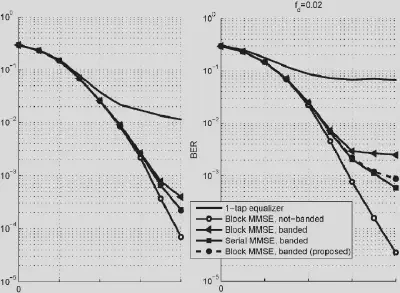
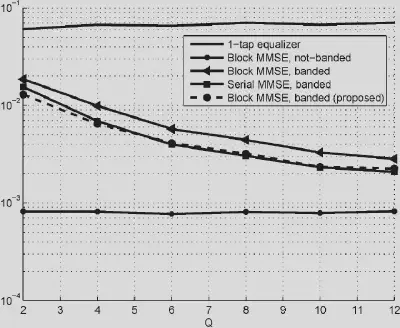
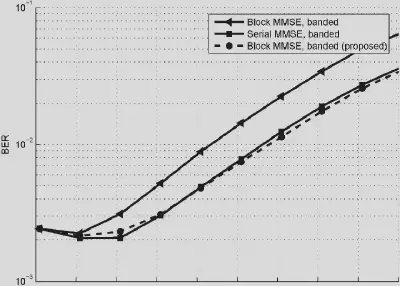
In this work, we consider a wireless OFDM system operating over doubly selective channels, where the Doppler effect destroys the orthogonality between subcarriers and hence, results into severe intercarrier interference (ICI). To mitigate this effect, computational demanding equalization schemes that require the inversion of the channel matrix, should be applied. In order to achieve linear complexity in the number of the subcarriers, a banded approximation of the channel matrix is usually adopted, whereas the performance of the equalizer is sig nificantly degraded. To recover this performance loss, we propose a regularized estimation framework for MMSE ICI equalization in the frequency domain, where the complexity remains linear with respect to the number of the subcarriers. Simulation results verify the effectiveness of the proposed regularization. I. INTROD UCTION Orthogonal frequency-division multiplexing (OFDM) has been used for several wireless applications such as broadcast ing of digital audio and digital video [1], [2] and mobile radio communication [3], [4].
Key Contributions
- Development of a regularized MMSE ICI equalization technique for doubly selective channels to mitigate the effects of Doppler-induced ICI in OFDM systems.
- Proposing a banded approximation for the channel matrix to reduce computational complexity while maintaining performance.
- Demonstrating that the regularized estimation can recover performance similar to exact MMSE equalization, offering a balance between performance and computational efficiency.
Results & Insights