Efficient Channel Estimation in Millimeter Wave Hybrid MIMO Systems with Low Resolution ADCs
Abstract
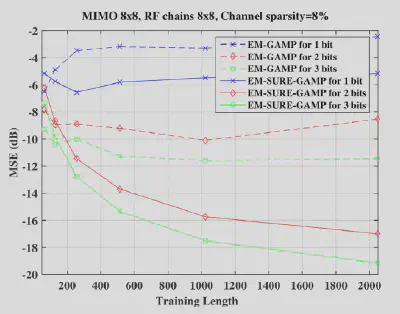
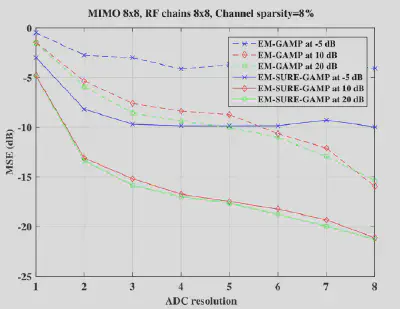
This paper proposes an efficient channel estima- tion algorithm for millimeter wave (mmWave) systems with a hybrid analog-digital multiple-input multiple-output (MIMO) architecture and few-bits quantization at the receiver. The sparsity of the mmWave MIMO channel is exploited for the problem formulation while limited resolution analog-to-digital converters (ADCs) are used in the receiver architecture. The estimation problem can be tackled using compressed sensing through the Stein’s unbiased risk estimate (SURE) based parametric denoiser with the generalized approximate message passing (GAMP) framework. Expectation-maximization (EM) density estimation is used to avoid the need of specifying channel statistics resulting the EM-SURE-GAMP algorithm to estimate the channel. SURE, depending on the noisy observation, is mini- mized to adaptively optimize the denoiser within the parametric class at each iteration. The proposed solution is compared with the expectation-maximization generalized AMP (EM-GAMP) solution and the mean square error (MSE) performs better with respect to low and high signal-to-noise ratio (SNR) regimes, the number of ADC bits, and the training length. The use of the low resolution ADCs reduces power consumption and leads to an efficient mmWave MIMO system.
Key Contributions
- Proposes an EM-SURE-GAMP algorithm that combines compressed sensing with expectation-maximization and adaptive denoising to exploit channel sparsity.
- Develops a solution that adapts to low-resolution ADCs by using an additive quantization noise model (AQNM) and minimizes estimation error through Stein’s Unbiased Risk Estimate (SURE).
- Demonstrates significant performance improvements in MSE across various SNR regimes, ADC bit resolutions, and training lengths compared to existing methods like EM-GAMP.
Results & Insights