Joint Localization and Channel Estimation for UAV-Assisted Millimeter Wave Communications
Abstract
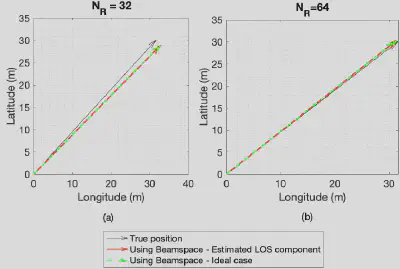
In this paper, we consider millimeter Wave (mmWave) communications between an Unmanned Aerial Ve- hicle (UA V) and a base station. By assuming that both com- munication nodes are equipped with arrays of multiple antenna elements, we focus on the joint estimation of the UA V position and the Multiple Input Multiple Output (MIMO) channel coefficients. Capitalizing on the line-of-sight signal propagation conditions and the beamspace representation of the wireless channel, we first estimate the UA V position. Using this estimation, we then present a matrix completion formulation for the recovery of the remaining non-line-of-sight components of the MIMO channel matrix, which is efficiently solved via the alternating direction method of multipliers. Selected simulation results for a 28GHz channel model verify that the proposed scheme is beneficial both in terms of estimation accuracy and resources utilization.
Key Contributions
- Exploiting the line-of-sight (LOS) propagation conditions and beamspace representation of the wireless channel to estimate the UAV position.
- Utilizing the estimated UAV position to formulate a matrix completion-based approach for recovering the non-line-of-sight (NLOS) components of the MIMO channel.
- Demonstrating superior performance compared to baseline methods, requiring fewer channel training resources.
Results & Insights